Joaquín Sorolla y Bastida was born in Valencia on 27th February 1863. His parents both died (probably from a cholera outbreak) when he was two years old, after which he and his younger sister were brought up by their maternal uncle and aunt, a locksmith and his wife, with no fortune, no patron and no name behind them. Everything that came afterwards he made himself, out of an enormous natural gift and a capacity for work that never left him.
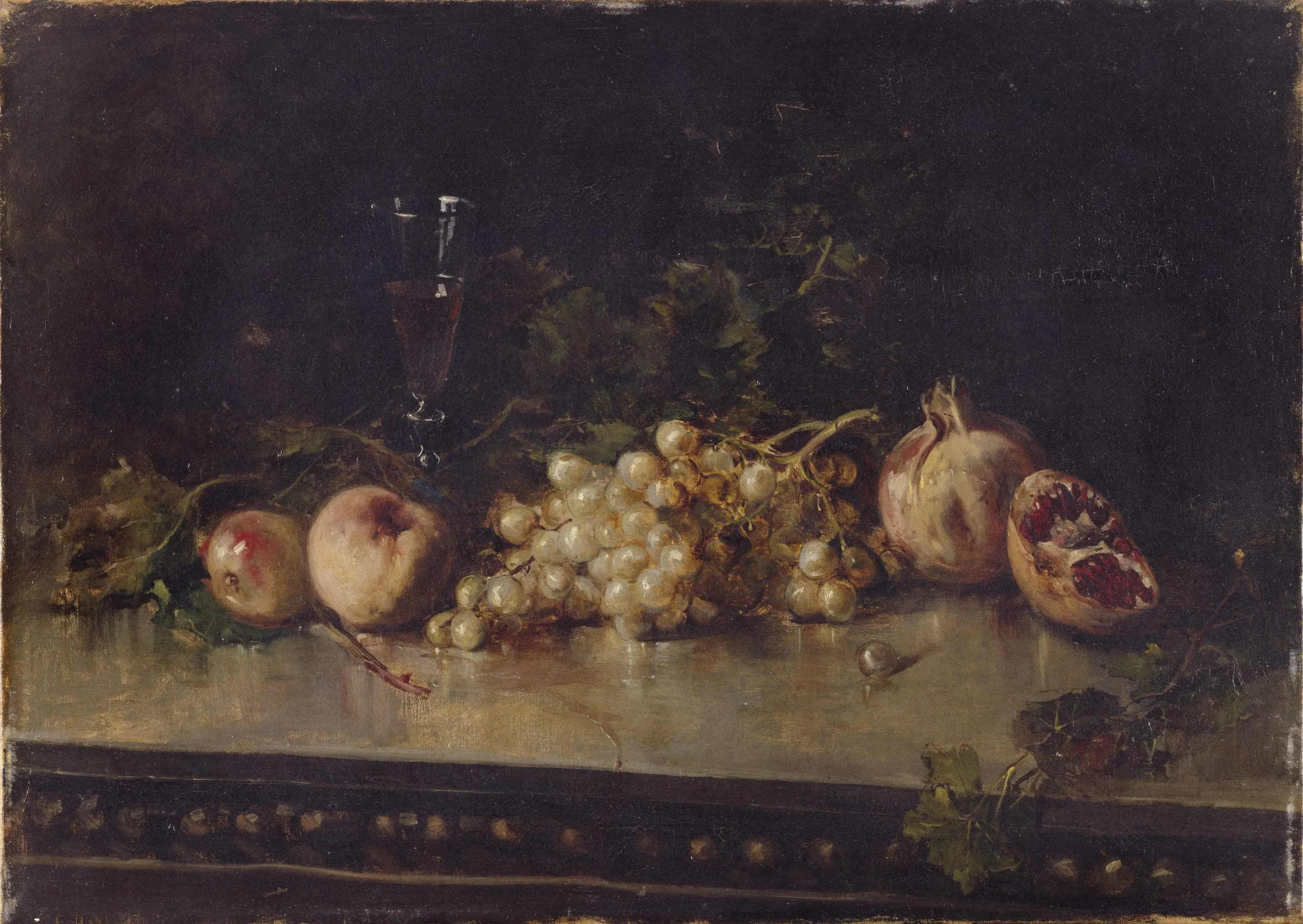
From an early age it was clear that Sorolla had a passion for art. The young Sorolla would spend much of his school days making drawings and, by the age of 15, he was winning prizes for his paintings at the Academy of Fine Arts of San Carlos in Valencia — the still life above, painted that same year, is his earliest known surviving work.
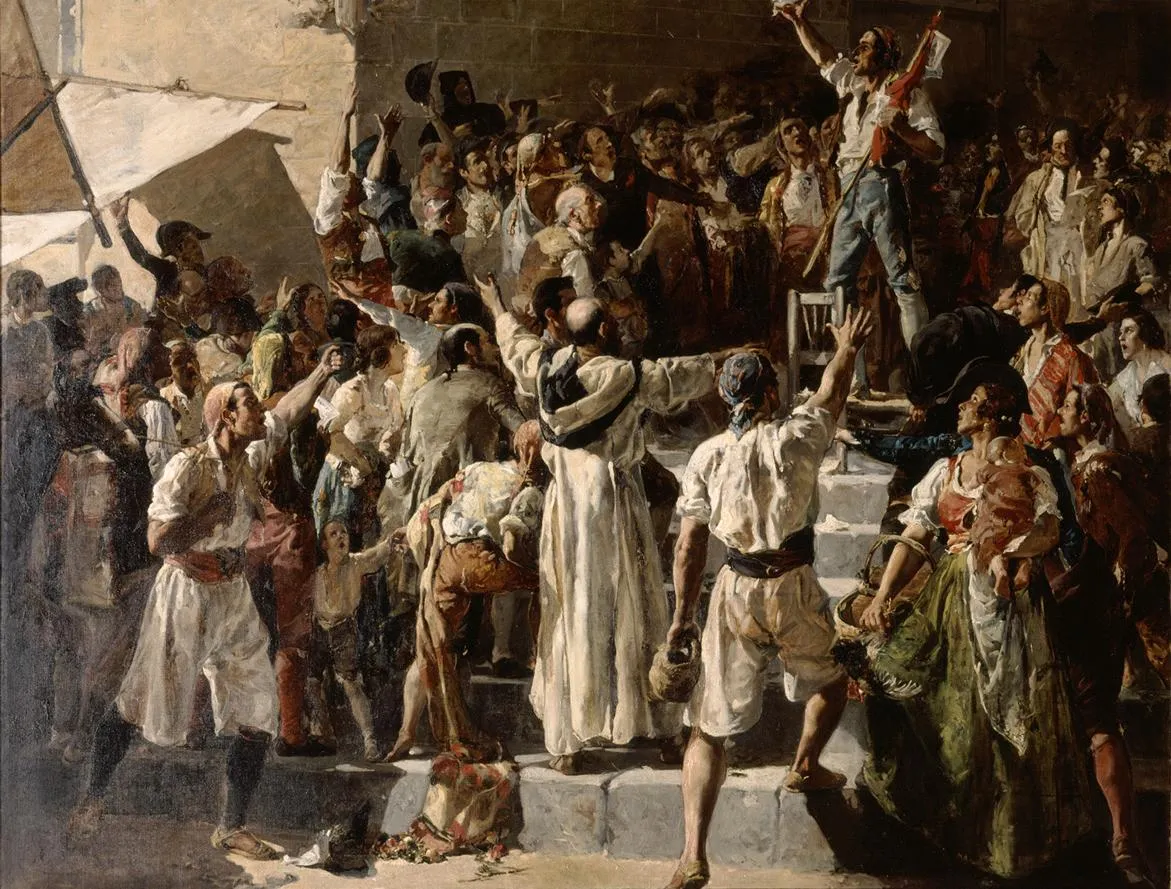
In 1884, aged 21, he won a four-year pension awarded by the Provincial Council of Valencia in open competition, submitting a large history painting on the theme of the 1808 War of Independence — El Crit del Palleter ("The Straw-Seller's Cry"), depicting the moment a Valencian street vendor rallied the city against the French occupation. The win sent him to study at the Spanish Academy in Rome. He travelled out at the start of 1885, and that same year made a formative visit to Paris, where he saw at first hand the French Impressionists' practice of painting from life, outdoors, in natural light — an experience that reshaped the way he worked for the rest of his career.
Sorolla's talent and hard work was brought to the attention of Antonio García, a pioneer in photography based in Valencia, who gave him his first real opening. In García's studio Sorolla worked and, in time, met his daughter, Clotilde García del Castillo; in 1888, at the age of 25, he married her. It was no marriage of convenience but a genuine, lifelong devotion — she is everywhere in his work, from grand society portraits to quick, tender studies on the sand.
By this time Sorolla was firmly established on the national stage and, by 30, he had displayed paintings in salons and international exhibitions in Madrid, Paris, Venice, Munich, Berlin and Chicago, receiving gold medals in several of them.
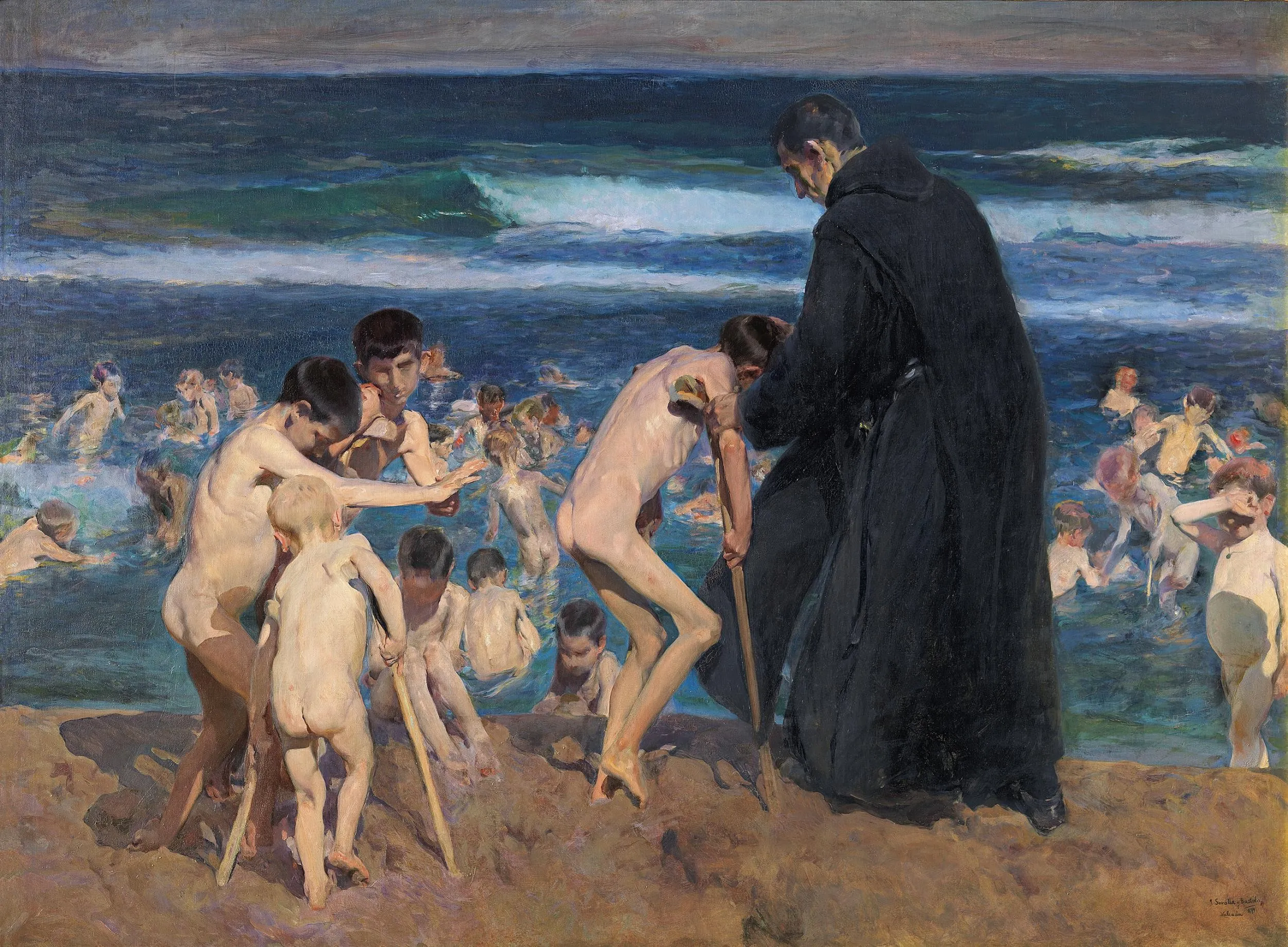
In 1900 he won the Grand Prix at the Paris Exposition Universelle for Sad Inheritance — the recognition that made his name in France.
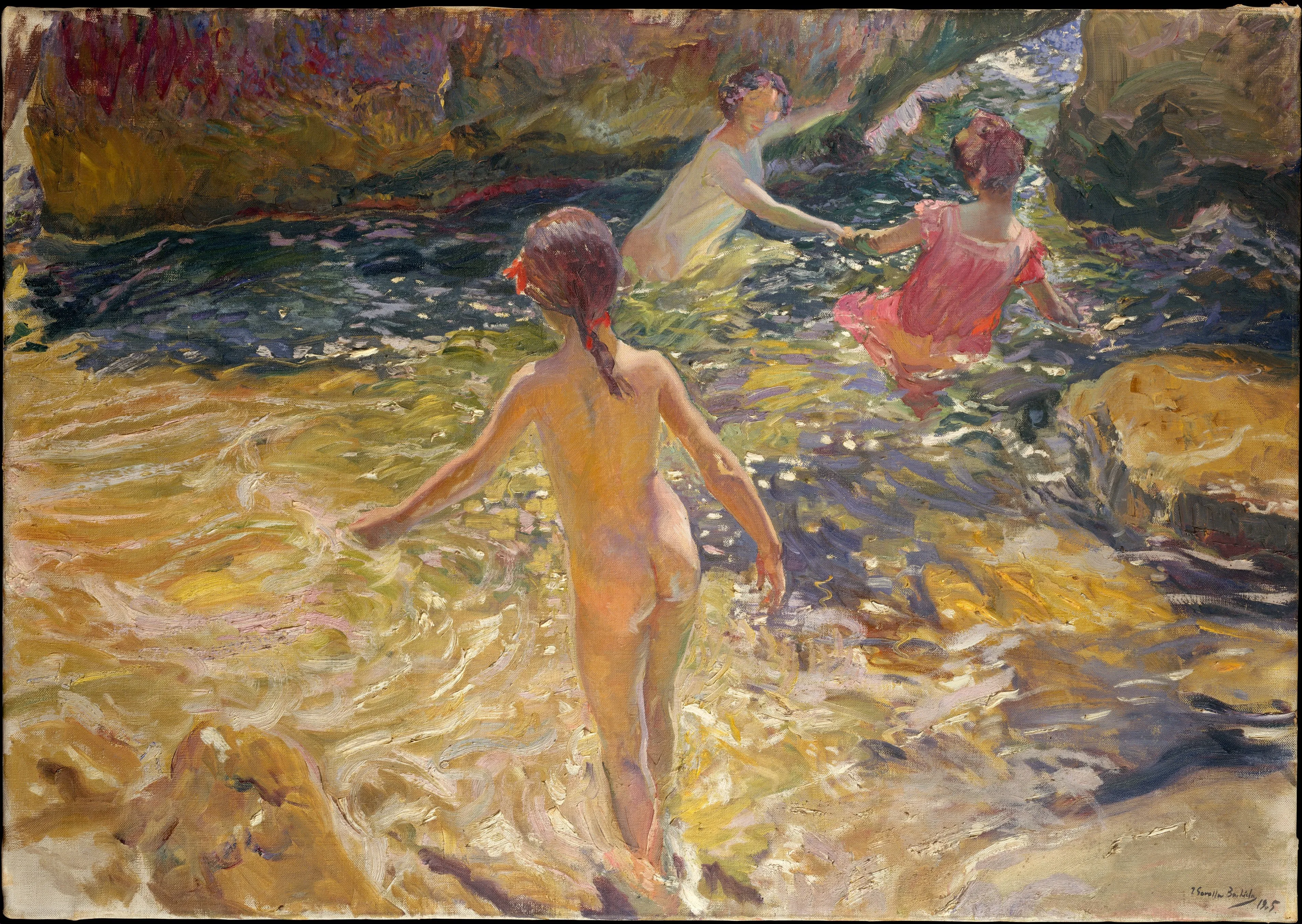
The first decade of the 20th century seems to me to have been the happiest and most lucrative time of Sorolla's life. As well as dropping the earth colours from his outdoor paintings and freeing up his brushwork during some wonderful summers in Jávea and in other places along the coast near Valencia, his incredibly successful exhibitions and portrait commissions (costing up to $5000 for a full-length portrait) made him a very rich man.
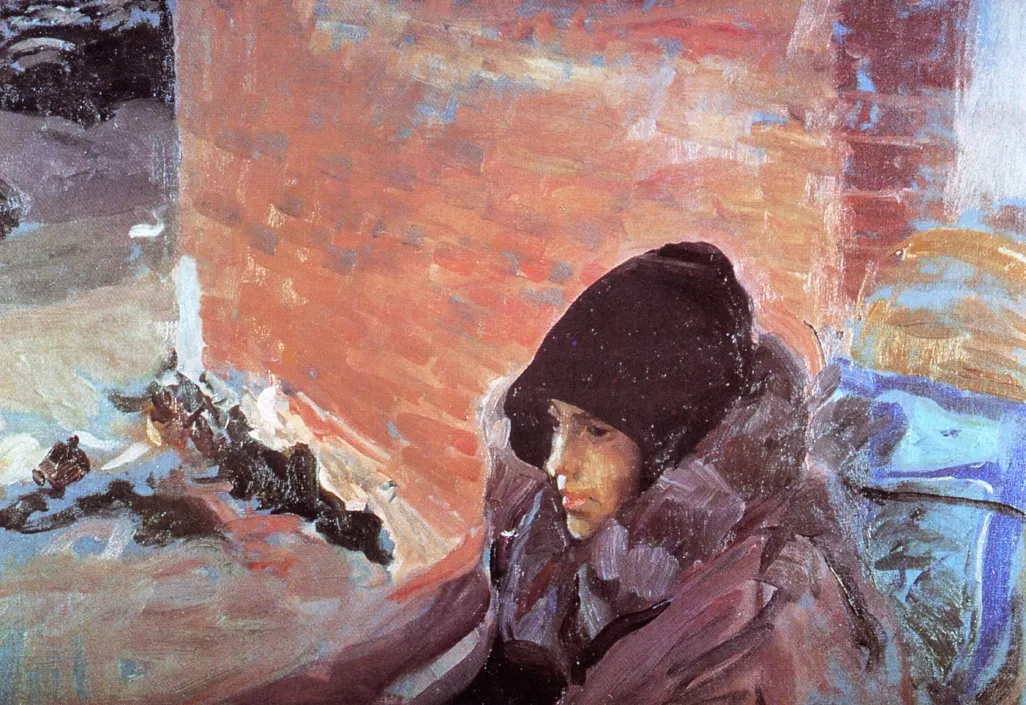
The joy of those years had a harder side too. In the winter of 1907 María, his eldest, fell seriously ill with tuberculosis; Sorolla painted her convalescing, wrapped against the cold, her face showing the strain of the illness and of a father's fear for her.
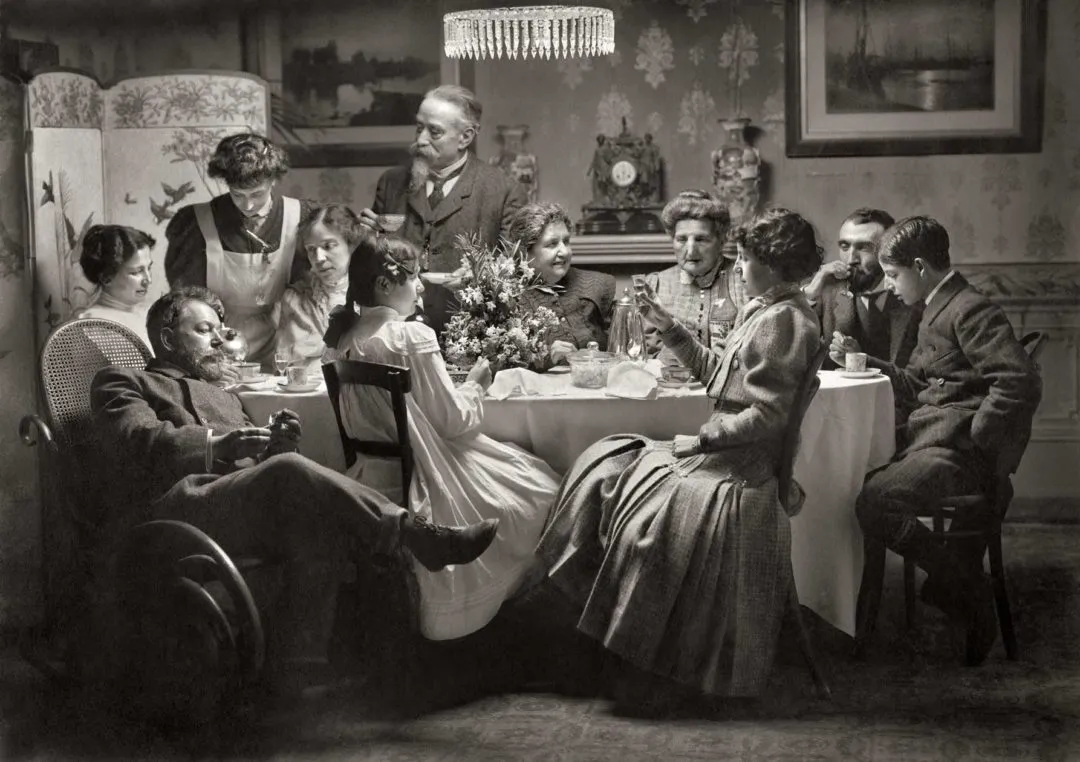
That same December, with María's health past its worst, the wider family gathered for a photograph of their own — not painted this time, but taken by Sorolla's father-in-law, at a table crowded with three generations.
America followed only two years later, with a single sensational month at New York's Hispanic Society in 1909. "World-famous" overstates what he was before then — celebrated at home, feted in Paris — but from that month on he was a sensation in America too.
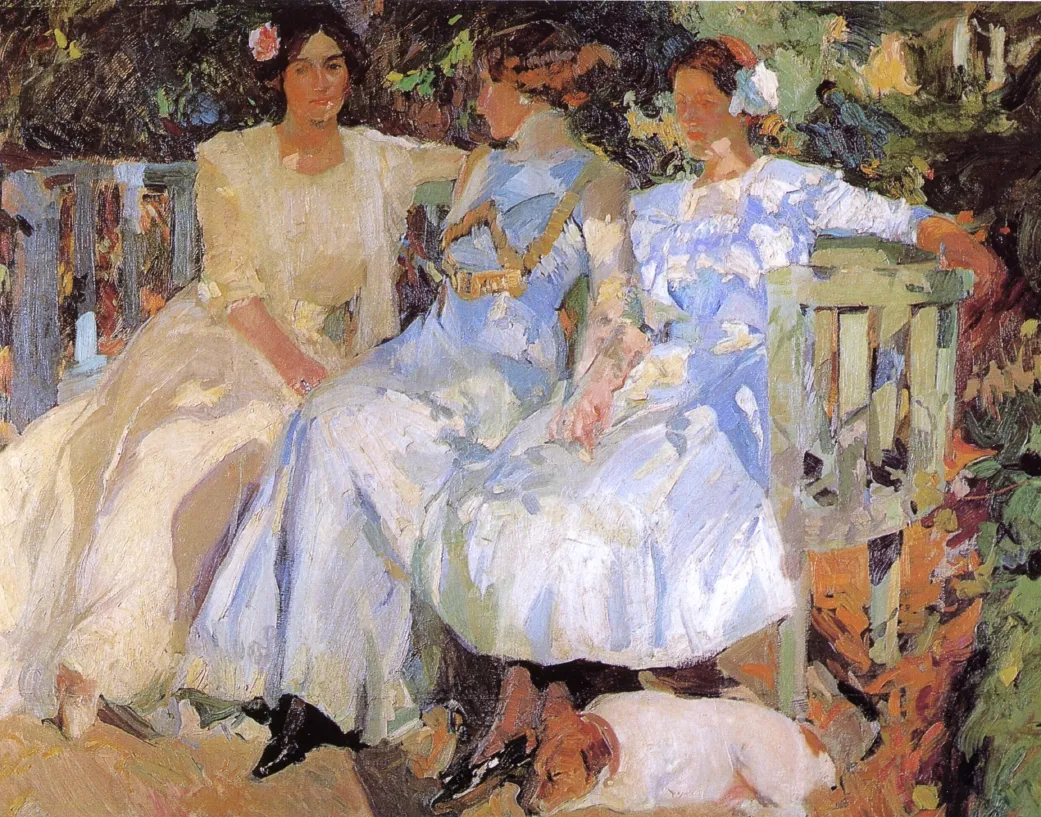
For all his fame, Sorolla's most constant subject remained the simplest one imaginable: his own family — María (born 1890), Joaquín (1892) and Elena (1895) — by the sea, in the light. He painted them again and again: the children running at the water's edge, Clotilde shading her eyes, an afternoon that would otherwise have vanished.
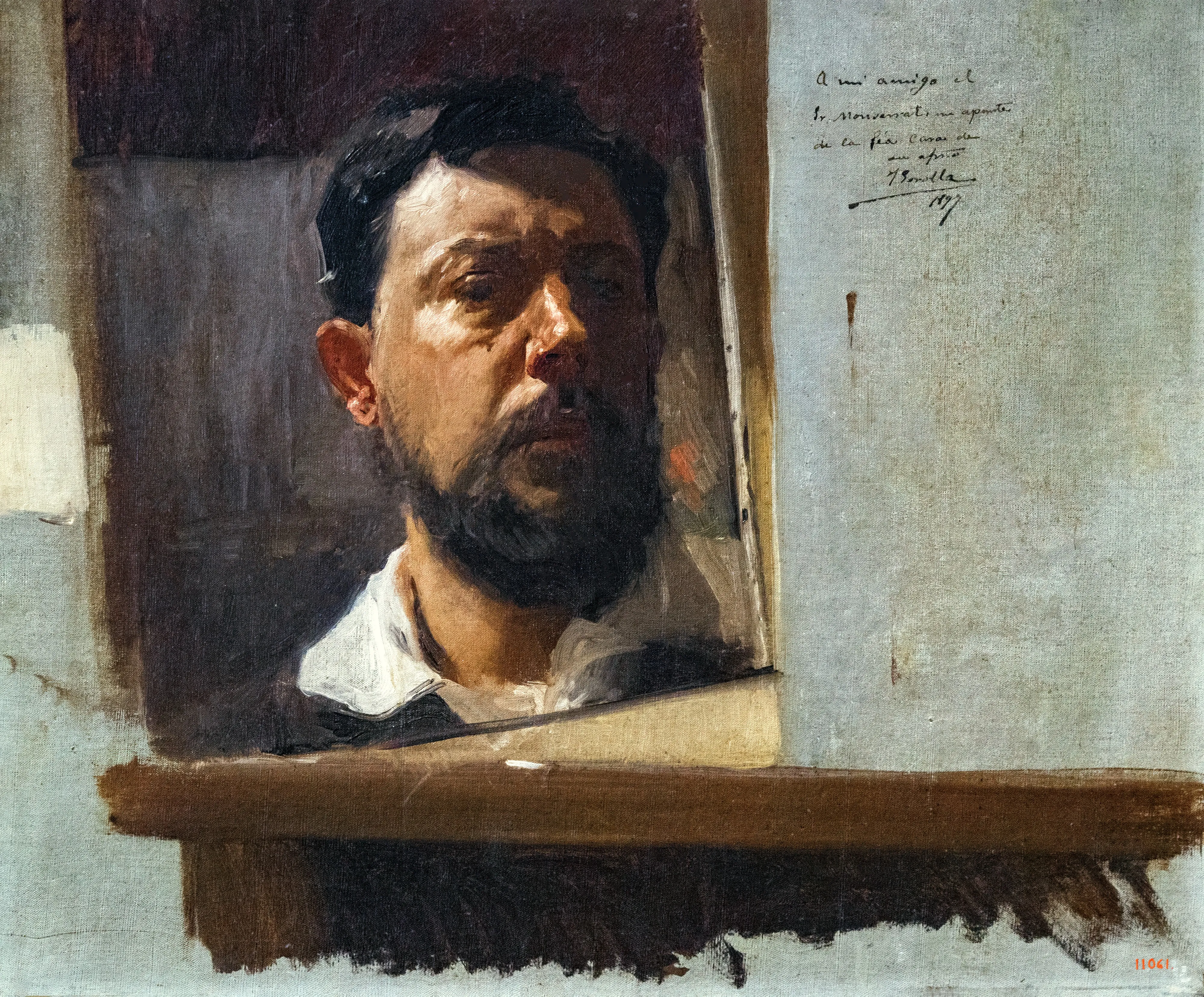
By every account he was warm, gregarious and generous company — boisterous, quick to laugh, quick to embrace a stranger. Yet underneath ran a real vein of anxiety: he was homesick almost from the moment he left Valencia, and success never quite silenced the doubt. He gave the world joyful, sunlit, openly beautiful painting just as the age was turning towards Cubism, abstraction and the difficult and the new, and he was privately uneasy about how the future would judge him for it — a fear that proved, for a time, well founded. His reputation fell sharply in the years after his death, dismissed as old-fashioned, before recovering across the following decades to its present height. The critics caught up with him in the end; he simply did not live to see it.
In 1912 Duncan Phillips Jr described meeting Sorolla a year earlier —
"I took the opportunity at Madrid last spring of visiting the painter in his new home. To my complete satisfaction he was just like his pictures. Whimsical, unconventional, jovial, kindly, the French would call him 'Bon garçon'."
"Sorolla was a charming host, putting my companions and myself at once at our ease by his almost boisterous familiarity, assuring us that although we were not painters, yet we were Americans, and therefore easy for him to like and understand. He spoke with enthusiasm of his friends in America, of his new commission to decorate the Hispanic Museum at New York with mural paintings, of his admiration for the American spirit, his belief that from us shall come the great art of the future."
"I drew him on to speak of his philosophy. He responded eagerly and with spontaneous eloquence. In answer to my remark that the distinguishing quality of his work seemed to be his responsiveness to the joyous influences of the world — he exclaimed that art has no business dealing with anything that is either ugly or sad. He had painted one pathetic picture of crippled children bathing in the sea. Emphatically he would never paint another like it; there was too much of that sort of thing in life. 'Is it any wonder,' he demanded, 'that modern painters love the study of sunlight? Light is the life of everything it touches.' And again a little later, 'La lumière c'est la vie.' Therefore the more light in pictures the more life, and the more truth, and the more beauty. Children, flowers, sunshine — yes, those were the things he loved best."
"And when I praised the beauty of his house and garden, he smiled as if remembering former doubts and compunctions about the realisation of this expensive dream, and said very simply, 'One can live only once. Let us be happy while we may.'"
In 1912 Sorolla took on the commission that would define his final working decade and, I have come to believe, help to end it. It came from Archer Huntington — the immensely wealthy American Hispanophile who had founded the Hispanic Society of America in New York — who asked him for a series of monumental panels depicting the regions of Spain. The canvases run to some two hundred feet in total length and stand up to about twelve feet high, sometimes obliging Sorolla to work from a ladder. He laboured at them until 1919; for the best part of eight years it pulled him away from the family and the Valencian coast he loved above almost anything.
It was an extraordinary feat, a fabulous historical record, and it made him a wealthy man. And yet, to my eye, something of him was lost to it. I do not find in most of the panels the loose, expressive freedom that pours out of his beach scenes and his gardens — the years of sustained, monumental work seem to have tightened his hand and drawn him away from the coast and the light he loved above almost anything. There are moments where the old spark flares up again — both painted in 1919, near the very end: Ayamonte: The Tuna Catch and, shown below, Elche, The Palm Grove. In those two, for me, Sorolla is wholly himself once more.
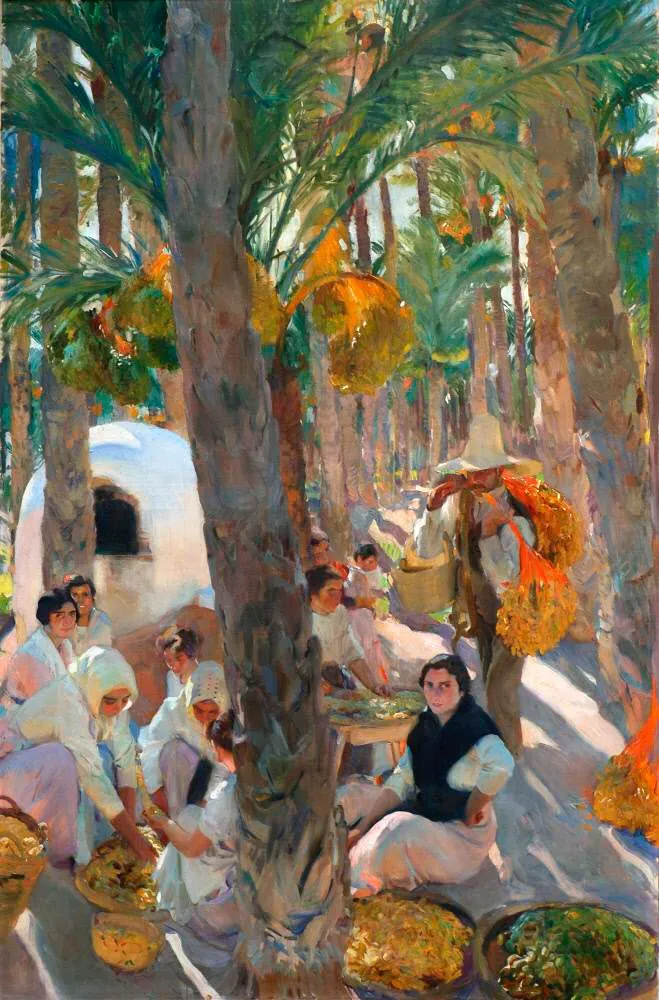
None of which is any charge against the Hispanic Society, which has been a devoted custodian of the Vision — and, increasingly, a generous one in sharing it. When the panels have travelled home to Spain they have drawn enormous crowds; I could barely get a ticket the year they were shown in Madrid, and found myself shoulder to shoulder with people who had come simply to stand surrounded by their own country as Sorolla had seen it. I have little doubt that, if and when they return again, they will be one of the great national attractions in Spain.
In 1920, while painting a portrait in the garden of his own house in Madrid, Sorolla suffered a paralysing stroke. He never painted again. He lived three more years, surrounded by the flowers and the light he had spent a lifetime chasing and could no longer set down, and died in 1923, only sixty years old — younger than I am now. Clotilde gave their home, with its studio and garden intact, to the nation; it opened as the Museo Sorolla.
I have visited that house, now the Museo Sorolla, many times. I find I cannot walk through its garden without picturing him there in those last years — surrounded by the light and the flowers he loved above almost anything, and no longer able to set any of it down on canvas. I cannot help feeling that, had that great commission not asked quite so much of him, there might have been more beach mornings and garden afternoons left in him. But perhaps that is only the sentiment of an admirer.
Through all of it — the poverty and the fame, the worry and the warmth, the triumph that cost him so much — the one constant is the looking. Sorolla loved the visible world with an uncomplicated, almost greedy delight, and he had the gift to give that love straight back to us. To stand before his work is to be handed, for a moment, his own astonished pleasure in the light.