The basis of Sorolla's faultless technique was the drawing skills he had learnt in his childhood. But he was not a slave to technique — truth and sincerity were his key objectives, and these came from observation and hard work.
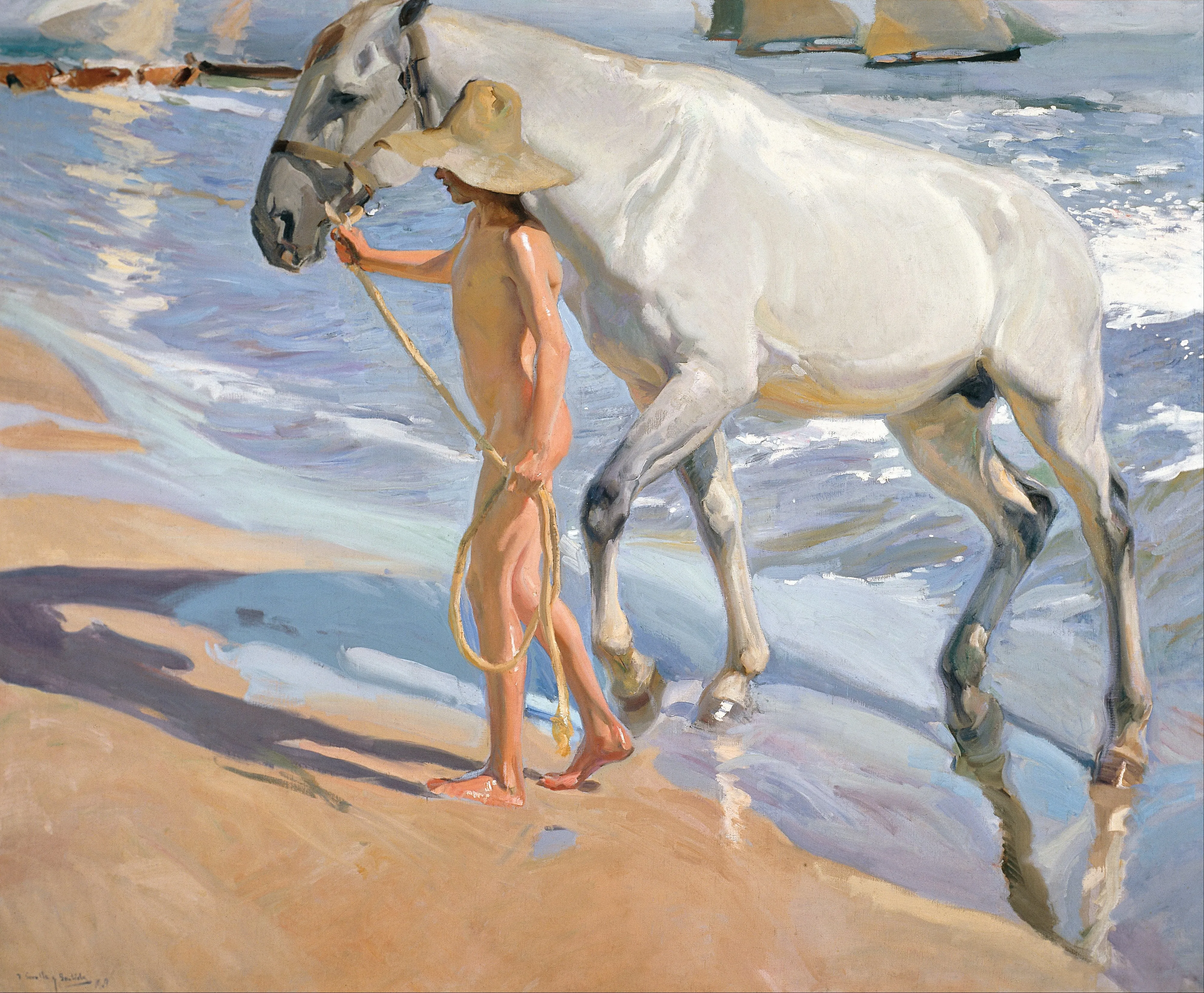
Sorolla painted very, very fast.
Besides Sundays, he would work six to nine hours a day, often standing in the full glare of the sun dressed in a suit. Most of his pictures were painted in from four to six mornings, many in one or two.
Sorolla did not have a set idea of how a painting would turn out before he started, preferring to build up the composition as he went along.
Palette
In terms of colour, from about 1900 onwards for outdoor work (as opposed to studio portraits), Sorolla dropped the "earth pigments" (umbers and the like), so his palette consisted of cobalt violet, rose madder, all the cadmium reds, cadmium orange, all the cadmium yellows, yellow ochre, chrome green, viridian, Prussian blue, cobalt blue, French ultramarine and lead white.
For studio portraits he changed his palette entirely, to one that included black, burnt umber, raw umber, rose madder, burnt sienna, raw sienna, yellow ochre, Naples yellow, vermilion and cobalt blue. Occasionally he would add orange, pink or purple, but he usually emphasised strong tonal contrasts over ambitious colour effects.
In the studio Sorolla would sometimes use a palette the size of a grand piano lid, and three-foot brushes to allow him to stand back from his painting.
Palette notes after Charles Sovek, Light & Colour, Sorolla Style.
When conservators at the Hispanic Society examined the Vision of Spain with X-ray fluorescence, they found exactly the palette you would expect of him: cobalt blues, chromium greens, ochres and cadmium yellows, vermilion, and a lead-white ground under everything.
The ground beneath everything; his light is built up from it.
Mixed with lead white for the brightest highlights.
The Mediterranean, the sky, and — thinned — his cool shadows.
The famous lilac shadows in sunlit white cloth and sand.
Chromium green for foliage, water and reflected light.
Warm earth for skin, sand and the weight of afternoon sun.
The high, singing yellow of full daylight.
Sashes, flowers, the flush of sunburnt skin.
Pigment identifications from the Hispanic Society's technical study of the Vision of Spain (Roldán, Ferrero, Juanes et al., X-Ray Spectrometry, 2011); the swatch colours above are representative of each named pigment, not samples from the paintings.
None of it came from nowhere. He revered Velázquez, whom he studied in the Prado — the source of his economy, his silvery greys, his way of letting a few sure strokes stand for a whole figure — and, after a formative 1885 visit to Paris, he had absorbed the lessons of French open-air painting, the Impressionists' insistence on working from life in natural light. What he added was his own: the sheer scale of his ambition, the speed, and a Mediterranean sun fiercer and more generous than anything Paris knew.
Light & Shadow
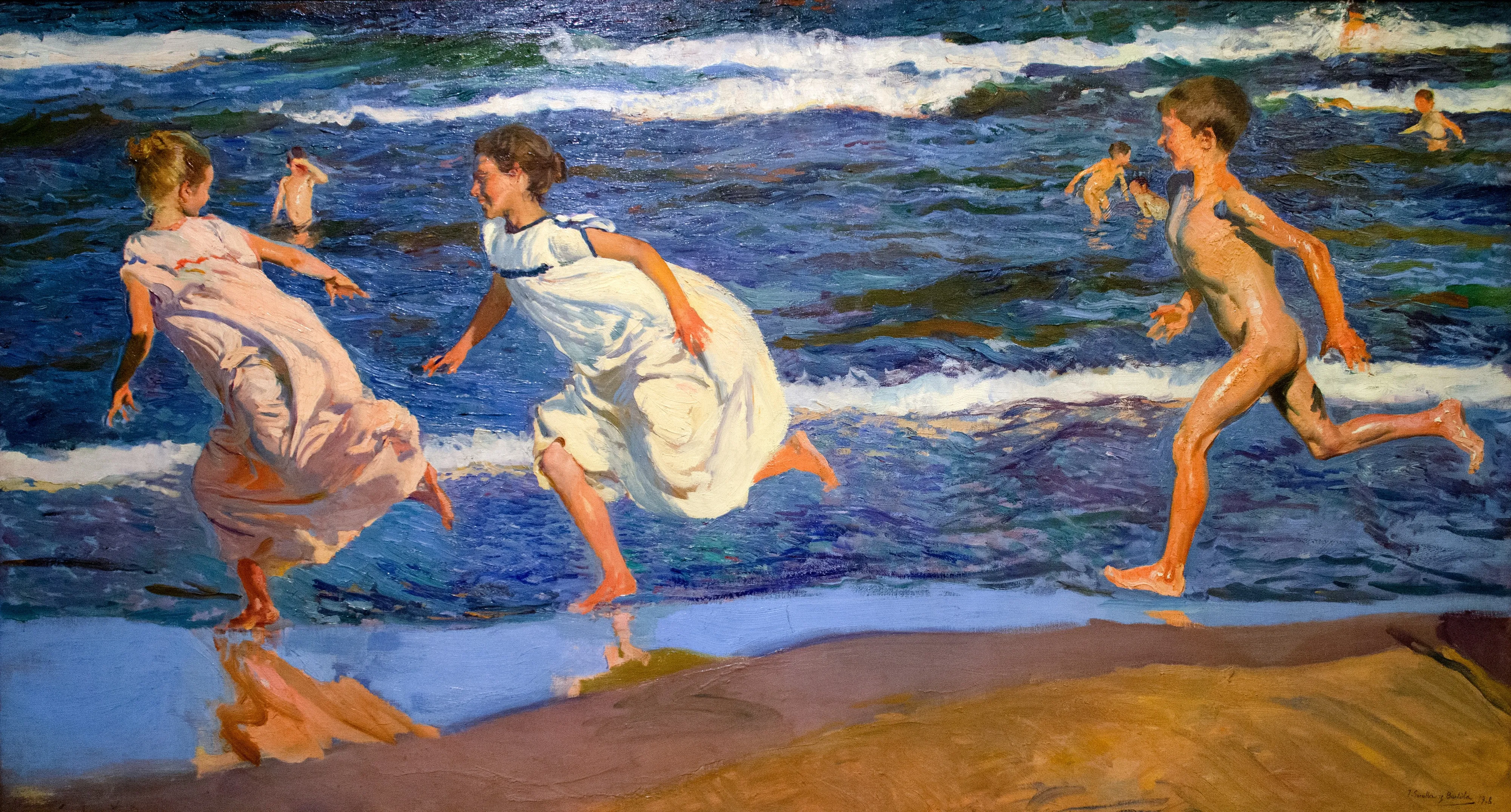
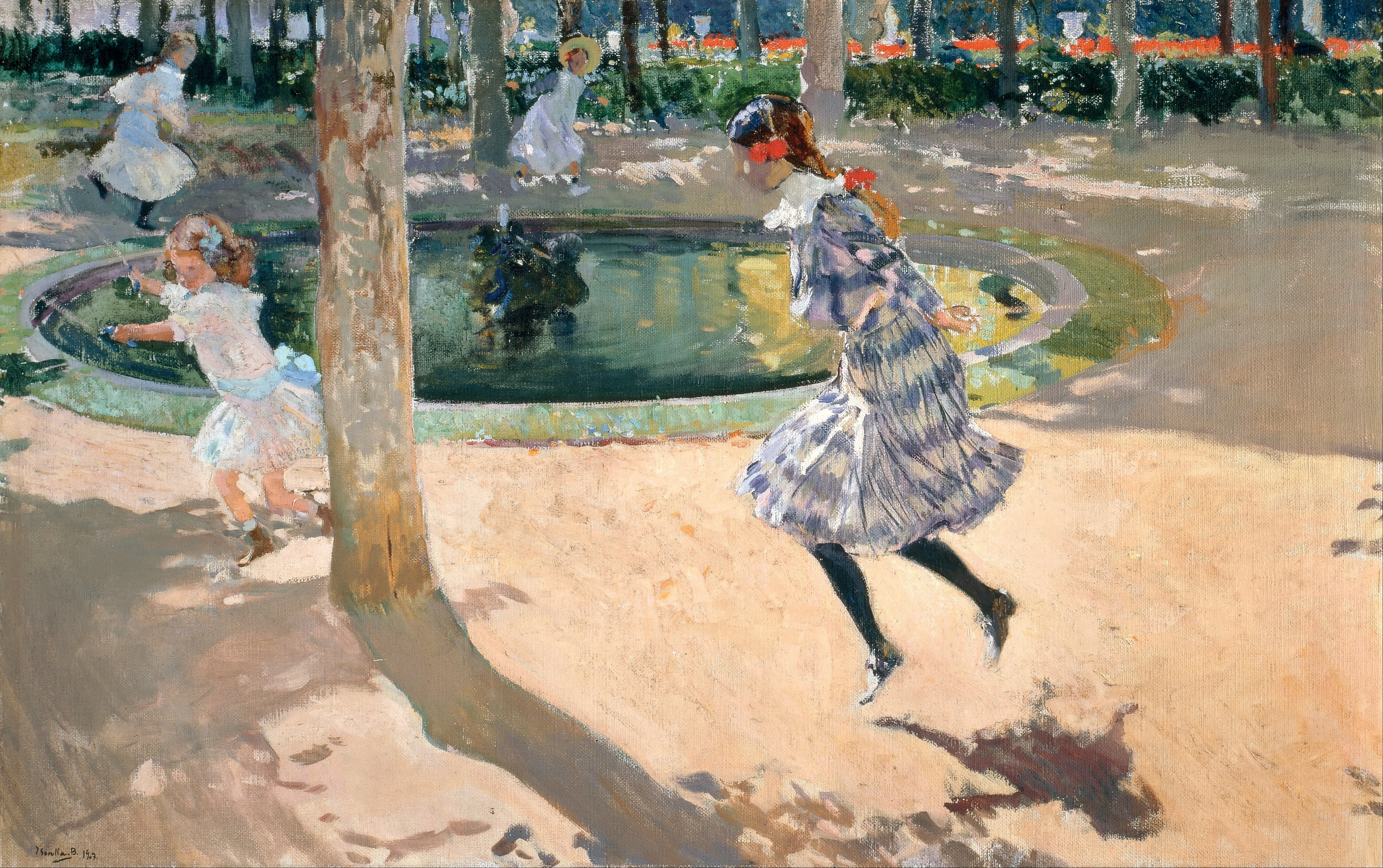
If there is one thing that marks Sorolla above every other painter of his century, it is what happens in the passage between sunlight and shade. Other painters painted light or shadow; Sorolla painted the transition — that fleeting zone, sometimes just inches wide, where full sun bleaches flesh or cloth almost white, then the tone turns, cools, and drops into colour-filled shade. This is the heart of what it means to call him the Master of Light.
These close-up details, photographed by Ian at the 2019 National Gallery exhibition, show that passage up close — the impasto, the loaded brush, and the speed with which Sorolla moved from full sun into tone.
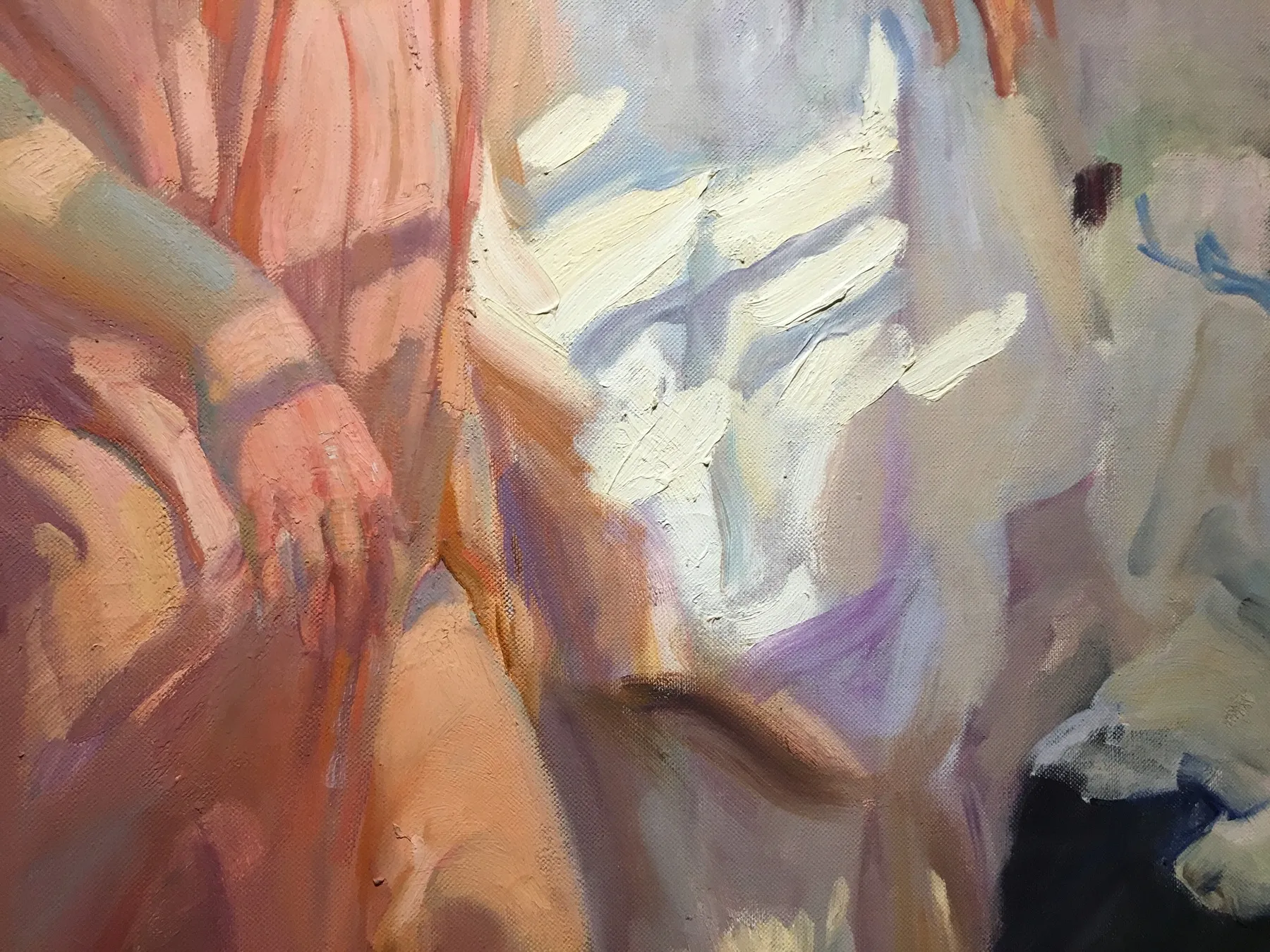
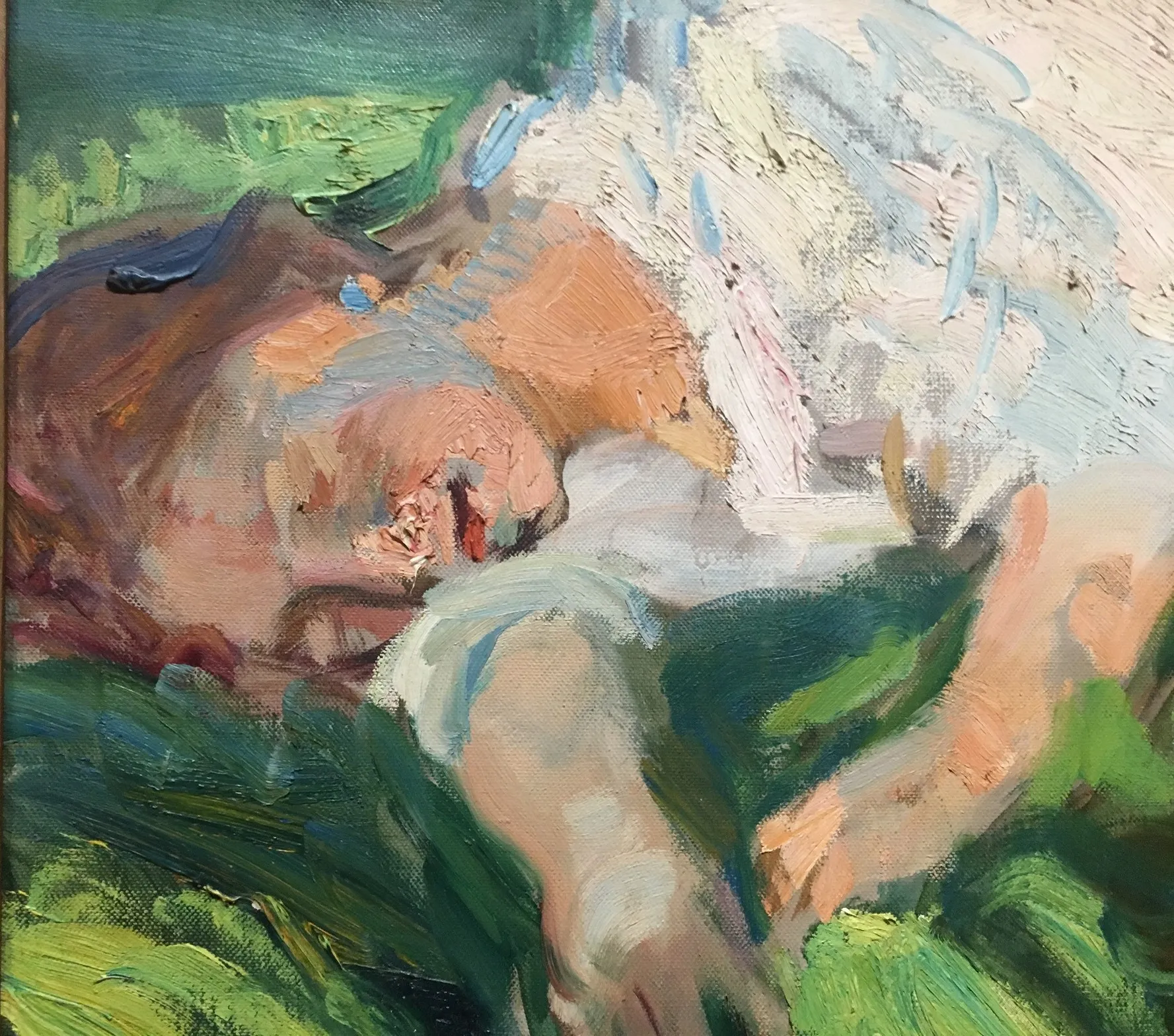
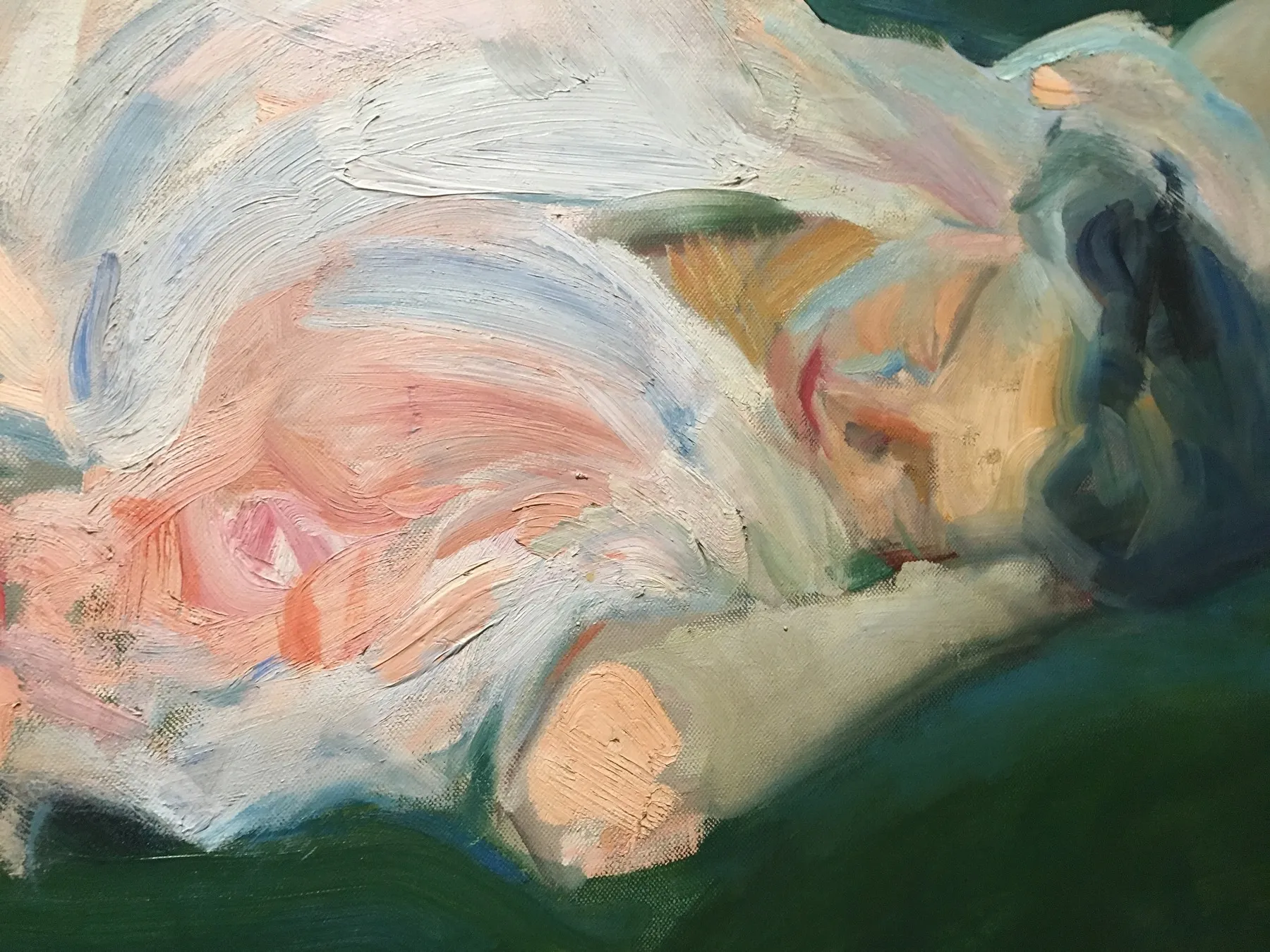
Detail photographed by Ian at the 2019 National Gallery exhibition, London.
Sorolla and the camera
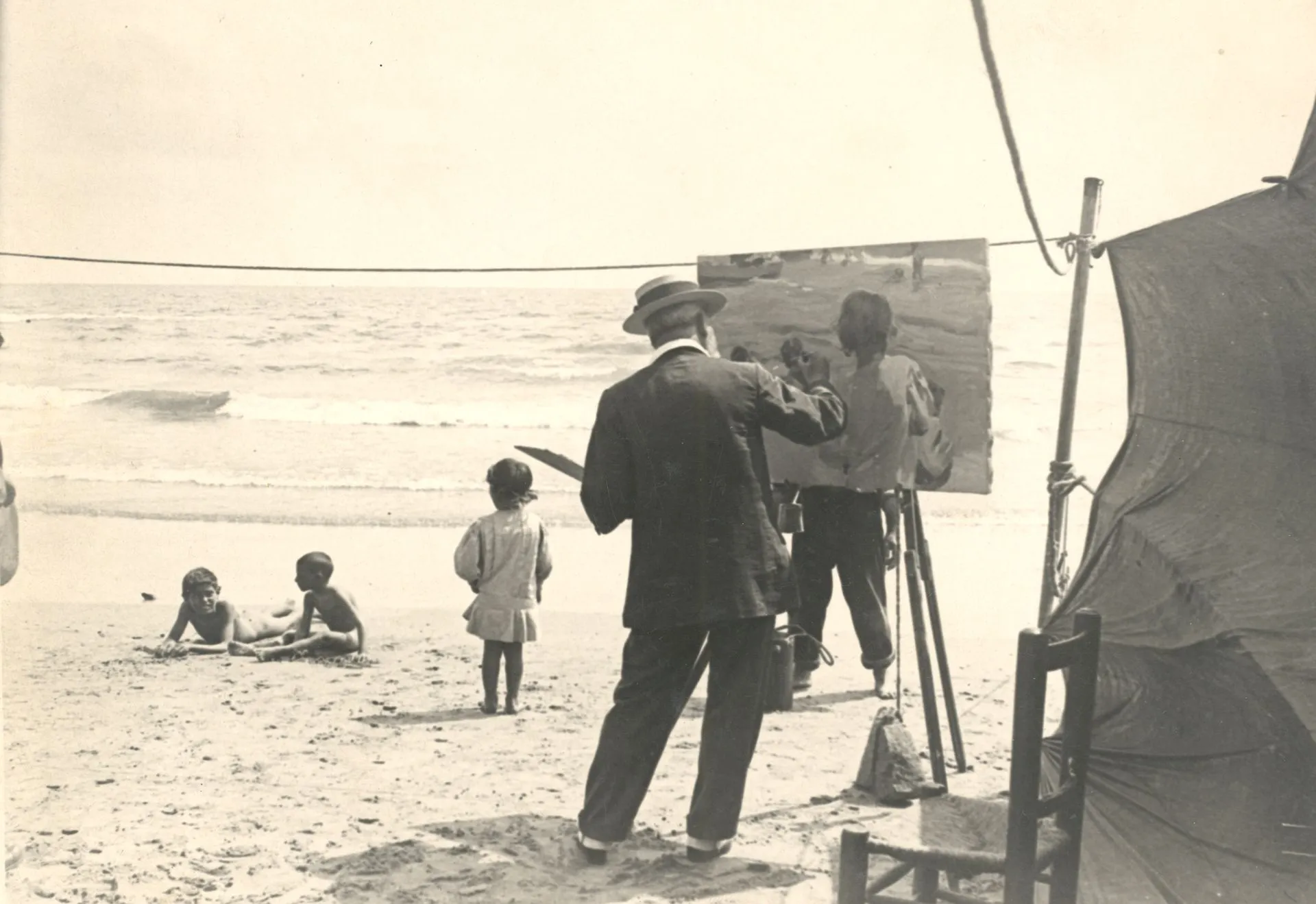
One question that has always fascinated me about Sorolla is how much he leaned on photography — and it has been debated since his own lifetime. Some point to his father-in-law, Antonio García, one of the foremost photographers in Spain and the Valencia agent for Kodak; to the surviving snapshots of his children playing on the beach; and to the painting he titled Snapshot, Biarritz — Clotilde on the sand with a little Kodak pocket camera in her hands.
But let us not forget how limited cameras were in those days: slow to use, blind to colour, and a moving subject would as often as not come out a blur. My guess is that he probably dabbled, and discussed it all in detail with García. Even if he did use it, the key thing is the outcome — the light and the warmth and the joy that jump out of the canvases could never have come from a photograph. The camera, whether he used it at all, would only have been in service of the painting, never the other way about.
In his own words
"I could not paint at all if I had to paint slowly. Every effect is so transient, it must be rapidly painted."
"The great difficulty with large canvases is that they should by right be painted as fast as a sketch. By speed only can you gain an appearance of fleeting effect. But to paint a three-yard canvas with the same dispatch as one of ten inches is well-nigh impossible."
"If ever a painter wrought a miracle of illusion with brush and pigment that painter was Velázquez in his 'Las Meninas', at the Prado in Madrid. Now, I have studied this picture with a lens, and what do I find? Why, that Velázquez got that marvellous atmospheric background by one broad sweep of his flowing brush, charged with thin colour — so thin that you can feel the very texture of the canvas through it. Nature, the sun itself, produces colour effects on this same principle, but instantaneously. The impression of these evanescent visions is what we make desperate attempts to catch and fix by any means at hand. At such moments I am unconscious of materials, of style, of rules, of everything that intervenes between my perception and the object or idea perceived. No, mes amis, impressionism is not charlatanry, nor a formula, nor a school. I should say rather it is the bold resolve to throw all those things overboard."
"I hate darkness. Claude Monet once said that painting in general did not have light enough in it. I agree with him. We painters, however, can never reproduce sunlight as it really is. I can only approach the truth of it."
"With all its excesses, the modern impressionistic movement has given us one discovery — the colour violet. It is the only discovery of importance in the art world since Velázquez."
"When an artist begins to count strokes instead of regarding nature he is lost. This preoccupation with technique, at the expense of truth and sincerity, is the principal fault I find in much of the work of modern painters."
"Go to nature with no parti pris. You should not know what your picture is to look like until it is done. Just see the picture that is coming."
"The older I become, the more I realize that drawing is the most important of all the problems of picture-making."
"I do not care to paint portraits indoors. I cannot feel sympathetic."
The standard biographical authority throughout this site is the art historian Blanca Pons-Sorolla, Sorolla's great-granddaughter, whose catalogue underpins everything serious written about him.